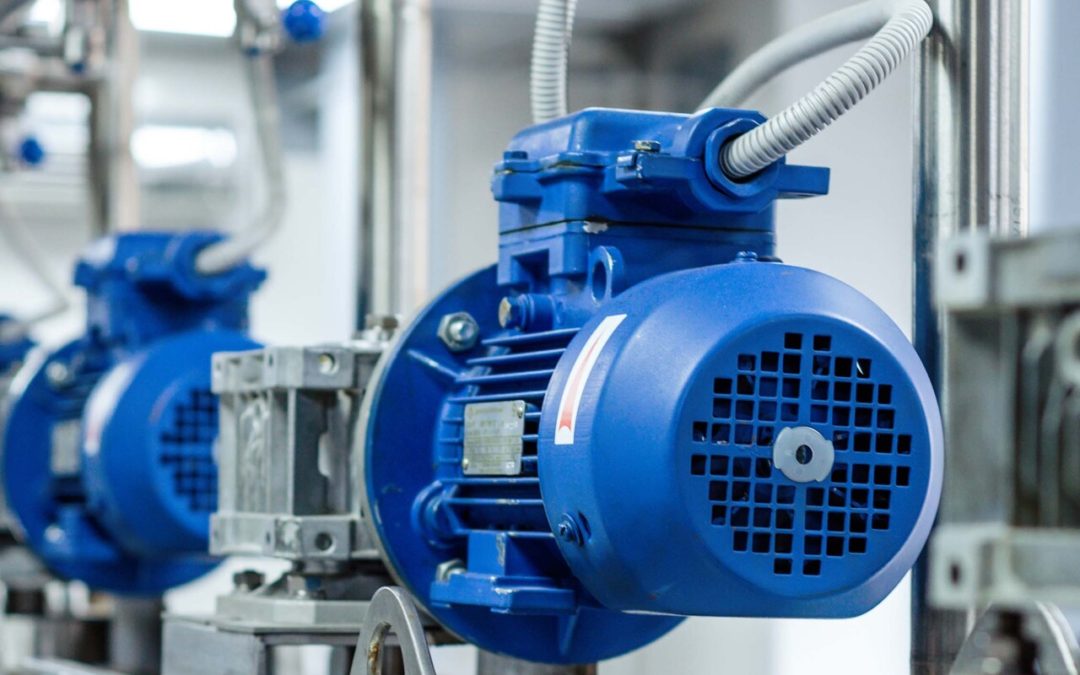
What is an industrial electric motor?
Electric motors are devices that have the ability to transform energy electric in energy mechanics and thus they can boost the operation of a machine. This occurs thanks to the action of magnetic fields that are generated using coils, What are the small cylinders with metallic thread?.
In this blog, let's get to know different types of electric motors and its areas of application.
Types of electric motors
• AC electric motors
• stepper motors
• DC motors
• motores brushless
1. AC electric motors
The principle of operation of alternating current electric motors consists of the rotating magnetic field, in which it creates a three-phase alternating current.
They are classified as follows:
Synchronous AC Motor
It is a device that has a permanent rotation speed and depends on the frequency of the voltage of the electrical network to which it is connected., as well as the number of pairs of motor poles. The name synchronous is due to the speed of the rotor and the speed of the stator magnetic field, which are equal..
These types of alternating current motors have three phases for starting.:
• Like an asynchronous motor
• like an asynchronous motor, but synchronized
• as an auxiliary motor for a start
Application areas: These motors are used in large machines that require a variable load with a constant speed..
Asynchronous AC motor or induction motor
It is a three-phase motor composed of two types of rotor: squirrel cage and winding.
The reciprocal exercise of the rotating field and the currents existing in the rotor conductors, initiate an electrodynamic force on said rotor conductors, which allow the rotation of the motor rotor. There is a difference between the speed and the rotor known as slip..
Application areas: for loads requiring high starting torque and where lower starting energy is needed, as well as loads requiring a gradual build-up of torque.
squirrel cage motor
The rotating part is made up of a group of conducting bars in the axial directions and placed cylindrically around the axis.. Its operating principle lies in the fertilization of a rotating magnetic field in the center of the motor, which is activated by a winding that receives its alternating electrical power source.
This rotating magnetic field causes currents in the bars that make up the rotor cage.. These currents activate a secondary magnetic field that interacts with the primary field., producing a torque or moment on the rotor.
2. stepper motor
In stepper motors we can find 3 different models:
- permanent magnet stepper motor
- resistance stepper motor
- the hybrid stepper motor which is the combination of both motors.
This combines the advantages of both motors and allows full, high torque to be applied when stationary and has a precise pitch angle.. The stepper motor also has a holding torque.
The disadvantage of a stepper motor is the high power requirement, since it has a tendency to run at maximum current by a motor controller. This can be counteracted with an encoder and connecting in a closed loop, if both are adapted to the application, only the required energy is consumed.
Application areas of a stepper motor The hybrid stepper motor is mainly required in industry for positioning tasks that require precise motion control.
3. Motor DC (direct current) direct current
DC motors are simple electric motors that run on direct current., They can also run on simple batteries. DC motors have two connections, one for the positive and one for the negative. Therefore, for different rotation direction of DC motor shaft, only power line connections need to be swapped. One of their advantages is that they are economical due to their simple design..
The disadvantage of DC motors without motor control is that they do not automatically shut down when torque increases., but they draw more and more current until they stop. If there is a permanent block, the motor could fail thermally. Another disadvantage is that it is more difficult to have control over the speed and position of these motors..
Application areas of a DC motor
Typical applications for DC motors are toothbrushes., toys for children or fans. However, They are also used in vehicles as a drive for the windshield wipers or seat adjustment. Besides, Simple screen settings can be implemented in the access controls area. DC motors are also used in furniture and caravan construction to adjust televisions.
3. direct current DC motor
DC motors are simple electric motors that run on direct current., They can also run on simple batteries. DC motors have two connections, one for the positive and one for the negative. Therefore, for different rotation direction of DC motor shaft, only power line connections need to be swapped. One of their advantages is that they are economical due to their simple design..
The disadvantage of DC motors without motor control is that they do not automatically shut down when torque increases., but they draw more and more current until they stop. If there is a permanent block, the motor could fail thermally. Another disadvantage is that it is more difficult to have control over the speed and position of these motors..
Application areas of a DC motor
Typical applications for DC motors are toothbrushes., toys for children or fans. However, They are also used in vehicles as a drive for the windshield wipers or seat adjustment. Besides, Simple screen settings can be implemented in the access controls area. DC motors are also used in furniture and caravan construction to adjust televisions.
Do you need maintenance of electric motors in Tarragona?
Contact us for all types of industrial electromechanical maintenance.